Sofa Dimensions: A Complete Sizing Guide
A standard sofa is 84 to 96 inches long, 35 to 40 inches deep and 30 to 36 inches tall. Here are the ranges by sofa type, the clearances that make a room work, and the measurements to take before delivery day.
Designer Discount Club
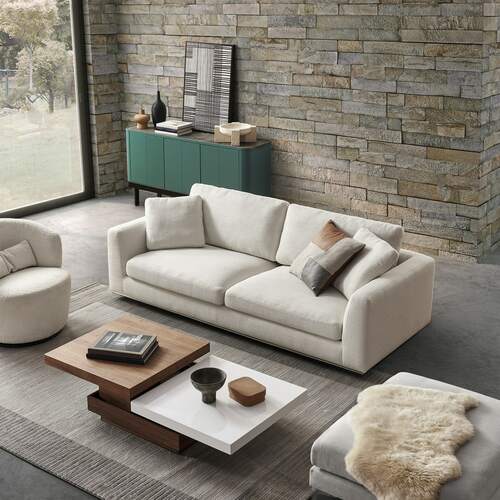
A standard sofa is 84 to 96 inches long, 35 to 40 inches deep, and 30 to 36 inches tall. Apartment sofas run 72 to 84 inches, loveseats 52 to 70 inches, and a two-piece sectional usually starts around 95 inches on its long leg and goes past 120. Seat height sits near 18 inches on most of them and seat depth near 21 to 24 inches, which is a different number from the overall depth and the one that decides how the sofa actually feels.
Those ranges hold up against what we actually sell. The typical sofa we carry is 88.6 inches wide, and two-thirds are 84 to 96 inches. Depth is usually about 39 inches and height about 32.
Key Takeaways
- •Standard sofa: 84 to 96 inches long, 35 to 40 deep, 30 to 36 tall.
- •Apartment scale starts at about 72 inches; a loveseat is 52 to 70.
- •Seat depth is 21 to 24 inches on most sofas and is not the same as overall depth.
- •Leave 30 to 36 inches for a main walkway and 18 inches to the coffee table.
- •The sofa should be roughly two-thirds the length of the wall it sits on.
- •Measure diagonal depth against your narrowest doorway before you order.
Standard sizes by sofa type
| Type | Typical width | Typical depth | Seats | Where it fits |
|---|---|---|---|---|
| Loveseat | 52 to 70 in | 30 to 38 in | 2 | Studios, bedrooms, a second seat opposite a sofa |
| Apartment sofa | 72 to 84 in | 32 to 38 in | 2 to 3 | Rooms under about 12 feet on the sofa wall |
| Standard sofa | 84 to 96 in | 35 to 40 in | 3 | Most living rooms |
| Grand sofa | 96 to 108 in | 38 to 44 in | 3 to 4 | Long walls and open plan rooms |
| Sectional | 95 to 130 in per side | 60 to 90 in overall | 4 to 6 | Rooms with a corner to give up |
The sectional row reads differently on purpose. A sectional's listed depth is the footprint of the whole L, not the front-to-back depth of one leg, so each leg of a 120 by 85 inch sectional runs about 39 inches deep overall like any other sofa. The typical sectional we carry measures 120 inches on its long side.
For the measured version of this table, medians and ranges computed from the recorded dimensions of every sofa and sectional we carry, see our sofa dimensions reference.
What a sofa costs
Across the sofa brands we carry, sofas run roughly $1,450 to $5,900 and center near $2,600. Sectionals center around $5,500 and climb well past $10,000 at the top. Prices move, so check the product page for the current one.
Almost nothing is sold as an apartment sofa, so read the dimensions rather than the name.
The fit rules
Walkways
Leave 30 to 36 inches for any path people walk through regularly, and never less than 24 inches to squeeze past. This is the measurement that decides whether people can move through the room without turning sideways at the same spot every day.
Coffee table gap
Leave 18 inches between the sofa and the coffee table. That is close enough to reach a glass from a seated position and far enough to stand up without a shin bruise. Fourteen inches is tight, 24 is a stretch.
The table itself should be about two-thirds the length of the sofa, and its top within a couple of inches of the seat height.
The two-thirds wall rule
The sofa should take up about two-thirds of the wall it sits against. On a 12 foot wall that is a 96 inch sofa; on a 10 foot wall it is closer to 80. The remaining third holds a side table and a lamp on one end and breathing room on the other.
Push past three quarters and the room reads crowded even when the walkways technically clear. Come in under half and the sofa looks stranded.
Behind and beside
Eighteen inches behind a floating sofa is enough to walk. Three inches is enough for a console table to sit flush without touching the frame. Give each end 6 to 12 inches of clear floor if you want a side table there.
Seat depth vs overall depth
Overall depth is the outside measurement, back panel to front edge of the seat cushion, and it is the number retailers list. Seat depth is the usable cushion, front edge to the face of the back cushion, and it is the number you feel.
A sofa with 40 inches of overall depth typically gives 21 to 24 inches of seat. The gap is the thickness of the back cushion plus the frame.
Which one you want depends on how you sit:
- 21 to 22 inches of seat. Upright and easy to get out of. Good for a formal room, for anyone under about 5'4", and for a room where the sofa doubles as everyday seating rather than a nap spot.
- 23 to 24 inches. The middle, and where most sofas land. Comfortable with your feet on the floor.
- 25 inches and up. A lounge seat. You sit back into it with your feet up, and most people cannot put their feet on the floor without perching on the edge. Deep-seat sofas usually need extra pillows to be usable upright.
If you want a deep seat, choose it on purpose rather than discovering it after delivery.
Seat height matters less but is worth a glance. Most sofas sit 17 to 19 inches off the floor. Under 16 and standing up takes noticeably more effort.
Sizing for an apartment
In a room where the sofa wall is under 12 feet, look at 72 to 84 inches wide and under 36 deep. That combination seats three across and leaves the walkway intact, which a standard 88 inch sofa at 40 deep often will not.
Two other things buy you space in a small room. Exposed legs let light and floor show under the frame, so the piece reads lighter than its footprint. Slim track arms give you seat instead of arm: a 3 inch arm on an 80 inch sofa leaves 74 inches of seating, while a 9 inch rolled arm leaves 62.
If the room is small and you are weighing a sectional against a sofa, the sectional guide has real widths for the compact configurations: best sectionals for small spaces.
Three sofas across the size range
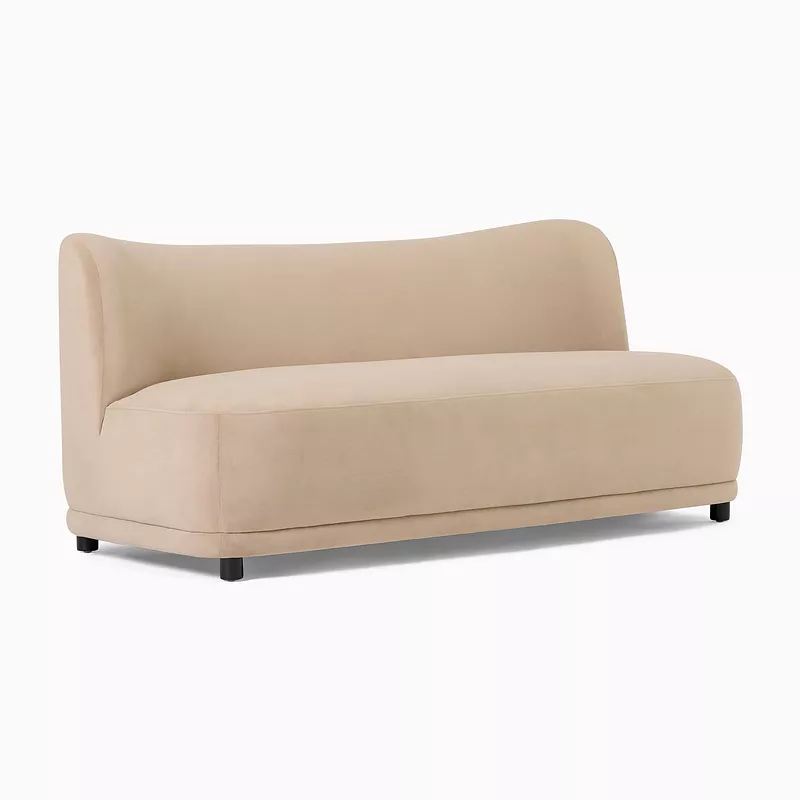
Mella Sofa by West Elm is 67.3 inches wide, 33.3 deep and 28.7 tall, which puts it below apartment scale and into the range where it works as a loveseat replacement. It is a minimalist take on a bat wing back, low to the ground, and West Elm scales it for apartments and smaller rooms. Upholstery is 100 percent polyester performance velvet.
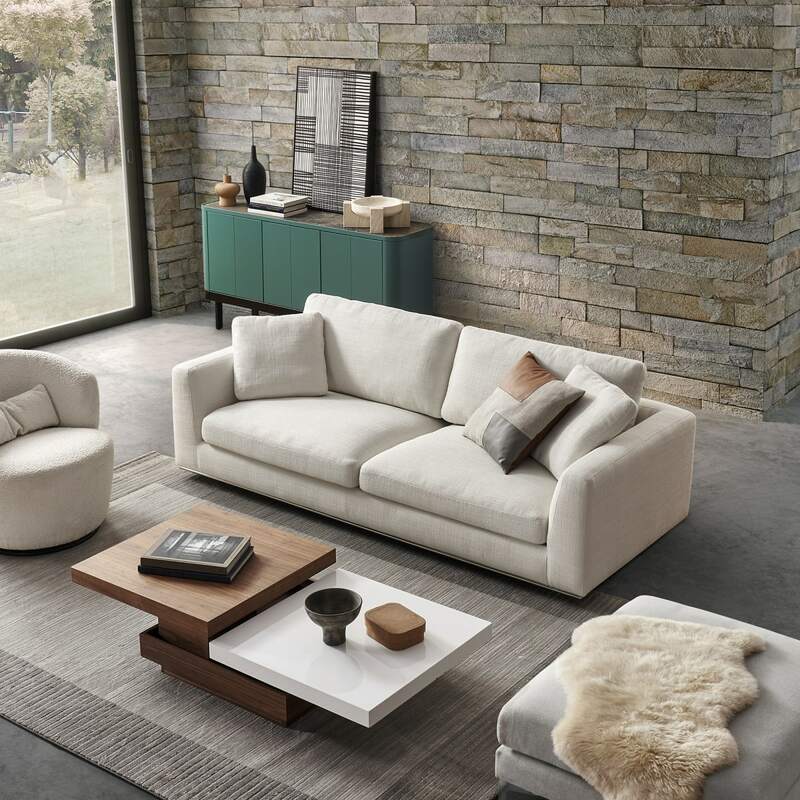
Hamilton Sofa by Castlery measures 88.6 by 39.5 by 32.3 inches, which is almost exactly the typical sofa we carry on all three dimensions. It has deep seats and extra cushions in a minimalist silhouette. The fabric is 97 percent polyester and 3 percent acrylic. If you are trying to picture what a standard sofa does to your floor plan, this is the one to picture.
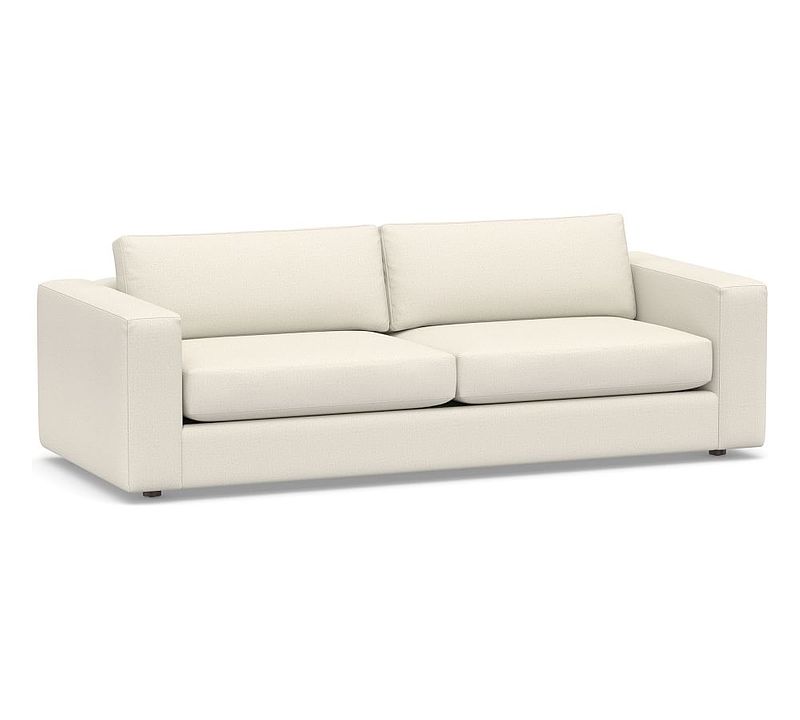
Carmel Square Wide Arm Upholstered Sofa by Pottery Barn runs 98.5 by 40 by 33 inches and weighs 220 pounds, so it is a grand-scale piece for a long wall. It pairs wide structured square arms with down-blend cushions. Note what those wide arms cost you: at 98.5 inches overall it seats about as many people as a narrower sofa with slim arms.
West Elm
Mella Sofa
📏 67.3"W x 33.3"D x 28.7"H
Unlock Member Pricing →
Castlery
Sofa, Performance Brilliant White
📏 88.6"W x 39.5"D x 32.3"H
Unlock Member Pricing →Pottery Barn
Carmel Square Wide Arm Upholstered Sofa
📏 98.5"W x 40.0"D x 33.0"H
Unlock Member Pricing →The delivery check
A sofa that clears the floor plan can still fail to make it through the door. Take these four measurements before you order.
- Diagonal depth of the sofa. Measure from the highest point of the back down to the front bottom edge of the arm. That diagonal is what has to clear a doorway when the sofa is tipped on its side. Compare it directly to your narrowest opening: it is often tighter than the listed depth suggests, and it decides whether the sofa goes through.
- Every doorway on the route. Width and height, including the front door, and remember that an open door eats an inch or two of the frame. Interior doors are often 30 to 32 inches.
- Hallway width and any turn. A straight hallway needs to be as wide as the sofa is deep. A 90 degree turn needs a hallway roughly as wide as the sofa is long, or a room to swing into.
- Stairs and elevators. Measure the stairwell at its narrowest, including the handrail, and the elevator door and car if there is one. If your building has a service elevator, check whether it needs to be reserved before delivery day.
Two things that save a delivery: legs on most sofas unscrew, which buys 4 to 6 inches of height, and a bench-seat sofa with one cushion is often easier to angle than a three-cushion frame of the same width.
Tape the sofa's footprint on the floor before you buy. Painter's tape takes ten minutes and shows you the walkway problem that a measurement on paper hides.
What members pay
Members pay 10 to 40 percent off retail on the sofas above, an average of $3,246 a year, and membership is free. Send our designers your floor plan and get a second opinion on the size before you commit; design help comes with every membership. A sofa is the order most likely to need chasing, so you also get a dedicated member success rep who takes a slipped delivery straight to the brand, and you reach them in chat rather than a phone queue. We partner with over 400 top brands and hundreds of thousands of products, so the sofa, the rug and the coffee table go in one cart and arrive as one order.
Frequently Asked Questions
How long is a standard sofa?
How deep should a sofa be?
What size sofa fits an apartment?
What is the difference between seat depth and overall depth?
How much space do you need around a sofa?
Will my sofa fit through the door?
How much does a sofa cost?
Before you order
Measure the wall, the walkways and the route in. Tape the footprint. Then check the sofa's own dimension list rather than its name, because the name almost never tells you the scale.
When you have the numbers, browse living room furniture to see sofas next to the tables and rugs they have to work with, or go straight to West Elm or Pottery Barn.
Join designerdiscount.club free, pick the sofa you measured for at member pricing, and let our designers settle the fabric question while your member success rep handles the order and the delivery date.

Enjoy exclusive interior designer trade discounts on furniture, decor, lighting, and more from over 400 top brands. Membership is free, and members save 10% to 40% off retail, an average of $3,246 a year, with one cart that works across multiple stores.